Hey there! I’m a supplier of Continuously Transposed Conductors (CTCs), and I’ve been in this industry for quite some time. One question that often pops up is, "How do continuously transposed conductors respond to sudden changes in current?" Well, let’s dive right into it. Continuously Transposed Conductors

First off, let’s understand what CTCs are. Continuously Transposed Conductors are basically a type of electrical conductor. They’re made up of multiple strands of insulated wires that are transposed continuously along the length of the conductor. This transposition is super important because it helps to balance the electrical characteristics of the conductor.
Now, when it comes to sudden changes in current, CTCs have some pretty unique responses. One of the key factors is the skin effect. You see, in an electrical conductor, when the current changes, the distribution of the current within the conductor also changes. The skin effect causes the current to flow more on the outer surface of the conductor as the frequency of the current increases. In CTCs, the continuous transposition helps to reduce the impact of the skin effect. When there’s a sudden change in current, the transposed strands ensure that the current is distributed more evenly across the conductor. This means that the conductor can handle the sudden change in current without overheating in certain areas.
Another important aspect is the proximity effect. When multiple conductors are placed close to each other, the magnetic fields generated by the currents in these conductors interact. This interaction can cause the current to be unevenly distributed among the conductors. CTCs are designed to minimize the proximity effect. The continuous transposition of the strands helps to balance the magnetic fields and ensures that the current is evenly distributed among all the strands. So, when there’s a sudden change in current, the CTC can respond more effectively because the current is flowing uniformly through all the strands.
Let’s talk about the resistance of CTCs during sudden current changes. Resistance plays a crucial role in how a conductor responds to changes in current. When the current suddenly increases, the resistance of the conductor can have a big impact on the overall performance. In CTCs, the design with multiple transposed strands helps to keep the resistance relatively stable. The even distribution of current across the strands means that the resistance doesn’t spike significantly when there’s a sudden change in current. This is really beneficial because it helps to prevent excessive power losses and overheating.
Now, let’s consider the inductance of CTCs. Inductance is related to the magnetic field generated by the current flowing through the conductor. When there’s a sudden change in current, the inductance can cause a back – emf (electromotive force) to be generated. This back – emf can oppose the change in current and affect the performance of the conductor. In CTCs, the continuous transposition helps to reduce the inductance. By balancing the magnetic fields and distributing the current evenly, the inductance is kept at a manageable level. This allows the CTC to respond more quickly to sudden changes in current and reduces the likelihood of voltage spikes.
In practical applications, CTCs are often used in high – power transformers and reactors. These applications frequently experience sudden changes in current, for example, during switch – on and switch – off operations or in the event of a fault on the electrical network. In a transformer, a sudden change in load can cause a rapid change in the current flowing through the windings. CTCs used in the transformer windings can handle these changes effectively because of their unique design features we’ve discussed above.
When it comes to reactors, which are used to control the flow of current and voltage in an electrical system, CTCs can also provide stable performance during sudden current changes. For instance, in a shunt reactor, a sudden increase in the system voltage can lead to a sudden increase in the current. The CTCs in the reactor can adjust to this change without significant damage or performance degradation.
So, to sum it all up, CTCs are pretty amazing when it comes to responding to sudden changes in current. Their continuous transposition design helps to reduce the effects of the skin effect, proximity effect, and keeps the resistance and inductance in check. This enables them to handle rapid current changes without overheating, excessive power losses, or voltage spikes.
If you’re in the market for high – quality Continuously Transposed Conductors, you’ve come to the right place. Whether you’re working on a power transformer project, a reactor installation, or any other high – power electrical application, our CTCs are designed to meet your needs. We offer a wide range of CTC products with different specifications to suit various requirements. Our team of experts is always ready to help you choose the right CTC for your project.
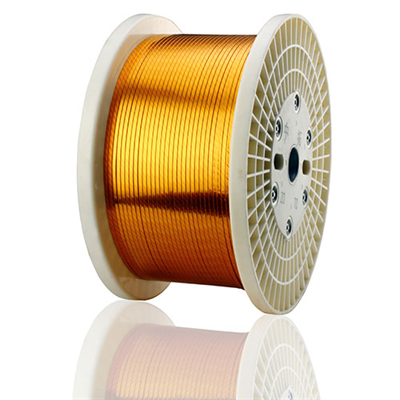
If you’re interested in learning more or getting a quote for our Continuously Transposed Conductors, don’t hesitate to reach out. We’re more than happy to have a chat with you about your needs and provide you with all the information you need. Just drop us a line, and let’s start discussing how our CTCs can benefit your project.
Enameled Round Wire References
- Grover, F. W. (1946). Inductance Calculations: Working Formulas and Tables. Dover Publications.
- Westinghouse Electric Corporation. (1950). Electric Transmission and Distribution Reference Book. Westinghouse Electric Corporation.
- Fitzgerald, A. E., Kingsley, C., & Umans, S. D. (2003). Electric Machinery. McGraw – Hill.
Tianjin Jingwei Power Technology Co., Ltd.
As one of the most professional continuously transposed conductors manufacturers and suppliers in China, we’re featured by quality products and good service. Please rest assured to buy durable continuously transposed conductors made in China here from our factory. Contact us for more details.
Address: No.1 Chuangxin Rd. Xiaozhan Industrial Park, Jinnan District, Tianjin, China
E-mail: info@jwdc.cn
WebSite: https://www.jw-dcs.com/
